Minorities in Iran: Nationalism and Ethnicity after Khomeini
 1515 clicked
Rasmus Christian Elling
2013
New York
Palgrave Macmillan
English
267
SOCIETY & CULTURE
Today, the minority issue constitutes a vast, this complex field of discussion driven by divisive notions of “identity.” Iranian nationalists fear that minority discontent and ethnicism pose an existential threat to a country otherwise known historically for its ethnic or national stability; ethnicists fear that they are facing cultural annihilation. Nationalist see this potential or imminent “identity crisis” as a result of foreign meddling, of elite mobilization or of faulty state policies; ethnicist see it as a result of deep-running chauvinism and historical injustice. No matter what their point of view, intellectuals, scholars, political activists, state ideologues and government officials have been forced to take a stand on an issue long distorted, forgotten or tabooed.
The political scientist Mehrzad Boroujerdi stated in 1998 that “many (ultra)nationalists worry that discussing the plight of ethnic minorities may open a Pandora’s box, and lead, even if indirectly, to Iran’s eventual breakup.” Today, the proverbial ethnic genie is out of its bottle, and this merits attention not just for reasons pertaining to Iran itself: the minority issue has several transnational dimensions, posing a challenge in an already volatile region. It is an issue that pertains to millions of people, some of whom are now openly asking immensely important questions: what is the place of minorities in modern Iran? What role should the state play vis-à-vis cultural diversity? How does the center relate to the periphery? Is the dominant notion of Iranian national identity inclusive? These questions, in turn, are directly related to the discussion about democracy and the future of Iran.
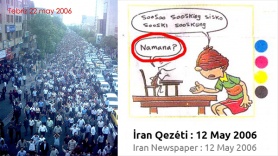
Contrary to the popular understanding of Iran as a Persian nation, half of the country’s population consists of non-Persian minorities, among whom there has been significant ethnic mobilization at crucial stages of Iranian history. One such stage is now: suppressed minority demands, identity claims, and debates on diversity have entered public discourse and politics. In 2005-2007, Iran was rocked by the most widespread ethnic unrest experienced in that country since the revolution. The same period was also marked by the re-emergency of nationalism.
This interdisciplinary book takes a long-overdue step toward understanding these highly contentious issues. In this book, I will also argue that the Iranian minority issue merits attention for academic reasons: it provides a highly informative arena for studying social action, cultural difference and ideology, and thus for testing and challenging certain key ideas in social science as a discipline and in Iranian Studies as a field.
Rasmus Christian Elling is Assistant Professor of Iranian Studies at the University of Copenhagen, Denmark. His research covers sociological issues of identity, urban life, and youth subculture in modern Middle Eastern history.